Name Image Likeness (NIL) began in the late 2000s when former UCLA basketball player Ed O’Bannon argued that college athletes should be paid for their use of their name, image, and likeness for commercial purposes. In 2014, a judge agreed with O’Bannon and decided that the NCAA’s restrictions on NIL earnings violated antitrust laws.
In July 2021, the NCAA allowed college athletes to start being paid through NIL deals. However, the NIL landscape has changed significantly in the last five years because of the rise of NIL collective organizations. Collective organizations play an important role when it comes to recruiting high school athletes. These third-party organizations, often supported by alumni or boosters, pool funds to help athletes at specific schools access sponsorships and partnerships. While these collectives operate independently from the universities, they play a significant role in connecting athletes with massive brand deals.
For example, Cody Campell, who runs the donor organization at Texas Tech called The Matador Club, has raised about $63 million since 2022, $55 million of which has gone to Texas Tech athletes. $27 million went to football alone. The Texas Aggies United donor party is also supporting the University of Texas A&M athletic program and has given $30 million to athletes.
Interestingly, these collective third party organizations are allowed to partner with corporations. such as Nike, Chick Fil A, Adidas. These partnerships are mutually beneficial.Many people were excited that athletes would be able to earn more money under NIL than they could in the past. However, some college coaches are upset with the lack of restrictions on NIL. Players are getting paid an astronomical amount of money through collective NIL third party organizations.Many believe these collectives – which were not envisioned when NILwas created – are unfair because the bigger schools will generate more money from wealthy alumni and brands, and this can be used to sponsor top-tier players. Coaches at smaller schools have a problem with this because their best players will transfer to a bigger school to earn more money.
As NIL has begun to rise, many believe that mid-major schools can no longer compete against power five schools. They simply can’t outbid the power five schools when it comes to money. For example, the University of Texas athletic department system had a revenue of $332 million and a budget of $500 million whereaswhere as mid-major High Point University had a budget of $2 million.
According to Pingree’s Matt Aliare, a former member of the FAU athletic department. “Nowadays with money a more influential factor, smaller schools don’t have the equity and resources to compete with bigger schools. The donors at mid-major schools don’t have the reasonable capabilities to compete with bigger schools.”
A mid-major school like Santa Clara University, which spent $4 million on their basketball team, is beginning to not be able to compete with the large basketball schools like Kentucky, which spent $22 million on their basketball team in the transfer portal and recruiting.
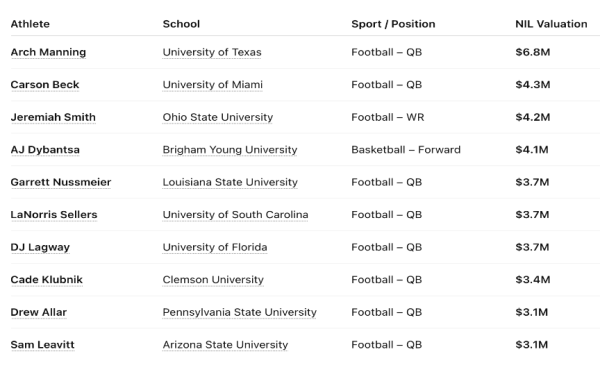
If you look at the top ten college athletes, they are all from a power five school and none of them are from a mid-major school. Also the top ten schools that spent the most money are all power five schools and no mid majors were even inside the top 70 when it comes to spending money on college athletes. This shows the inequity from the mid-major school to the power five schools as they are able to generate and spend more money.
 Within the next 10 years, these collective organizations will likely get bigger and more profitable. NIL will cause the colleges to generate and make more money than professional sports leagues – something that many people think needs to be addressed to ensure college sports remains an amateur sports league rather than a pro league.